Information Brief
A Brief on KEPRO EPR Councils
An introduction to KEPRO EPR Councils, their role, strategic objectives, formation and eligibility
Background on KEPRO
KEPRO is the Kenya Extended Producer Responsibility Organization, a private-sector-led non-profit organization bringing together key players in the packaging industry for the non-hazardous products waste value chain to address post-consumer waste in Kenya as per the Sustainable Waste Management Act of 2022 and Producer Responsibility Organization (PRO) obligations of the Extended Producer Responsibility (EPR) Regulations.
KEPRO aims to accelerate the growth of Kenya's Recycling Ecosystem and create a Circular Economy that protects the natural environment and creates jobs for future generations. Our approach is based on the implementation of an EPR model that extends the responsibility of producers to the post-consumer stage of a product's life cycle. KEPRO's EPR model is based on the Gram-for-Gram (G4G) concept used to depict the efforts that KEPRO makes to ensure that out of every material fraction packaging volume declared and paid by producers has been sustainably managed, recovered and recycled into secondary raw materials and/or products.
The Packaging for Non-Hazardous Products includes:
- Plastics (Flexible Plastics, PET Plastics, Rigid/Hard Plastics)
- Papers & Cartons
- Glass
- Metals such as Aluminium cans, etc
- Composites
The Packaging Value Chain Stakeholders include:
- Raw Material compounders and suppliers
- Packaging Manufacturers and Convertors
- Packaging Users inclusive of brand owners, re-fillers, packers and importers
- Retailers inclusive of supply chain operators, supermarkets & non-supermarkets
- Waste Management Operators (WMOs) inclusive of waste collectors, sorters, aggregators, value adders, and recyclers
Other Strategic Partners and External Stakeholders include:
- National and Local Governments
- Business and Membership Organizations
- International Partners
- Entrepreneur Maker Communities
- Consumers and the General Public
Introduction to EPR Councils
The KEPRO EPR Councils are based on a broad or narrow material fraction in the packaging for the non-hazardous products value chain with representation across the entire packaging value chain.
Formation: Invited by the KEPRO Board, the KEPRO EPR Councils includes a minimum of seven (7) representatives across the entire Value Chain.
Value Chain Representation: The council members act as representatives across the broad or narrow material fraction within the packaging value chain they represent inclusive of Flexible Plastics, PET Plastics, Rigid/Hard Plastics, Papers & Carton, Glass, Metals, and Composites.
Board Representation: Each EPR Council is represented on the KEPRO Board within the 16-Seat Composition (so that the entire value chain is represented at Board and EPR Council level).
Role of KEPRO EPR Councils
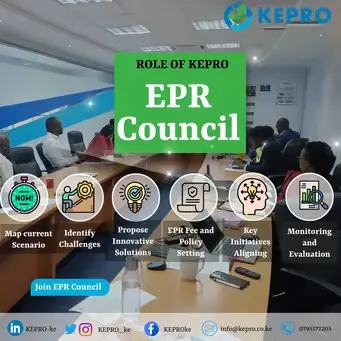
Each material fraction EPR council convenes strategic meetings and plays the below roles:
- Mapping Current Scenario: Mapping the current waste generation, recovery and recycling rate
- Identifying Challenges: Identifying the challenges to achieving local circularity and the costs underpinning the recyclability at scale
- Proposing Innovative Solutions: Identifying and outlining the innovative solutions to improve circular applications
- EPR Fee and Policy Setting: Aligning and setting the EPR fee and subsidy policy for effective recovery and utilization
- Aligning on Key Initiatives: The EPR council recommends the key initiatives and areas of focus
- Monitoring and Evaluation: Monitoring the performance of the EPR scheme, understand the gaps, and recommend any key initiatives for implementation
Strategic Meeting Objectives
Meeting 1: Situation Analysis & Fact Finding
- Identification of the representatives and different actors and the nomination of officials.
- Estimate the quantity of the packaging waste generated, recovered, and recycled per month.
- Identify the key actors in the Manufacturing, Usage/Production/Importation, Distribution, Retailing, Collection, Sorting and Recycling of the packaging.
- Identify the barriers across the value chain to achieving local circularity.
- Assess the costs and complexity underpinning the collection, sorting, and recycling of the packaging at a scale.
- Identify innovative solutions to improve the collection, sorting, recycling, and circular or downcycling applications.
Meeting 2: EPR Fee & Subsidy Policy Setting
Propose and Align on Projects/Initiatives for Execution
- Align on the EPR subsidy that would increase collection, sorting and recycling rate to produce local recycled output that has demand at scale
- Align on the EPR fee to be set for Producers considering the potential EPR subsidy funding required and EPR fee compliance expected
- Set Timelines and Targets for Implementation of the proposed EPR Fee and Subsidy Policy, projects and initiatives for execution
- Define and set the EPR Fee and Subsidy Policy for the Packaging based on the agreed structure to be presented to the Recycling G4G Committee and KEPRO Board for approval and implementation
Meeting 3: EPR Fee & Subsidy Policy Review & Course Correction
- Conduct a mid-year review to assess growth in recycling rate and achieving targets
- Conduct a broader review to assess upstream and downstream improvements in product recyclability & recycled material offtake, and shift towards circularity
- Deliberate course correction measures on non-policy actions and implement them immediately
- Deliberate course correction measures on policy-based changes & prepare to update EPR Fee and Subsidy Policy during the next meeting
Eligibility to the EPR Councils
All representatives in the council ought to be:
- Compliant* members (companies) of KEPRO,
- Packaging value chain actors* in the specified waste streams,
- Represent the different tiers (large, medium, and small) members,
- Experts in the industry
Expression of Interest Form
Join the KEPRO EPR council and contribute to the journey towards a circular economy in Kenya. Fill in the below expression of interest form, and you will be notified when the next EPR council is meeting and how you can participate.
Notes
*Compliant KEPRO member: A member who has paid the annual membership fee for the year and for producers, who have done the monthly volume declarations and relevant EPR fee payments. Not a member? Join KEPRO here
*Packaging value chain actors: Refer to packaging manufacturers, packaging users and brand owners, retailers, and recycling value chain actors.
Embracing Circularity
Accelerating Recycling
Closing the Loop